Join the Newsletter!
Latest Book
Categories
Community
Connect

The Fashion World of Cleopatra Selene and the Augustan Age

An Ancient Roman Woman Getting Ready to Go OutCleopatra VII of Egypt was the most fashionable woman in the ancient world. Like a modern day celebrity, she set the trends. During her visit to Rome, she made such a sensation that Roman matrons hurried to copy her distinctive hairstyles. It’s hard to believe that her daughter didn’t inherit just a touch of Cleopatra’s sense of style.

One of the most enjoyable things about writing my book was researching the clothes, cosmetics, jewelry and hairstyles of the period. But whereas Cleopatra was a trendsetter who ushered in an era of extravagance, such lavish indulgence went out of style after the famous queen’s suicide.

As if to define himself as the very opposite of the defeated Queen Cleopatra, Augustus preached of simple virtues, wearing homespun clothing and encouraging the women of his family to dress as modestly as possible. His wife, Livia, owned expensive jewelry (some of them having belonged to Cleopatra) but she seldom wore them in public, claiming that her children were her jewels. In official statuary, Livia and the other women of the imperial family are always portrayed in frumpy swaths of cloth, practically mummified in the name of virtue.

However, the emperor’s daughter, Julia Caesaris, is known for having worn fashion-forward clothing in public, in spite of her father’s complaints. During the Augustan Age, transparent Coan cloth was very popular, and it is thought to have been a form of silk. If dyed in expensive colors like purple or indigo, such a garment could have funded a small army. A woman’s gown always fell to her feet–only prostitutes wore anything short enough to show off ankles and knees. However, it’s almost certain that even well-bred ladies gave a flash of leg because the Romans didn’t have buttons or zippers or other modern fastenings. They used pins and clasps to keep their clothes fastened and for wealthy women, this was the way to show off expensive jeweled brooches.

And oh, how ancient Roman women loved to show off their jewelry and gems. Cleopatra Selene is known to have worn her mother’s amethyst ring, the famous one with which Cleopatra was said to have bewitched Mark Antony. It’s likely that she inherited some of her mother’s other famous adornments–perhaps some of the giant pearls and emeralds. I absolutely love the  serpentine armlets that were popular at the time, but I often wonder if the historical Selene would have wanted to raise that spectre of her mother’s apparent suicide by snake.

Women of the upper classes in Augustan Age Rome plucked all the hair from their bodies and used cosmetics. Given Selene’s Egyptian heritage, she may have lined her eyes with kohl, but given her strict upbringing in the emperor’s household, she’s unlikely to have painted her face until after she became queen in her own right.

Given her adherence to Isis, she may have worn her gown knotted between her breasts, and of course, when she became Queen of Mauretania, Gaetulian purple was one of her biggest exports, so she undoubtedly draped herself in imperial purple!

Review of Stacy Schiff’s Cleopatra

I couldn’t be more pleased about the resurgence of interest in Cleopatra VII of Egypt. Given that I’ve spent the past few years of my life working on a trilogy about Cleopatra’s daughter, I admit a ready bias in favor of Stacy Schiff’s new biography. However, I believe that this book would appeal even to those who don’t have an obsession with Egypt’s most famous monarch.

Schiff’s tone is easy and breezy–injecting humor and modern comparisons into this survey of the queen’s life. I appreciated the thoughtful analyses of the more hotly debated aspects of the queen’s life and Schiff very wisely refrains from taking a side. Instead, she explores each side of the argument, seldom throwing her weight behind anything that can’t be proved. (One exception to this is the manner of Cleopatra’s death. Though ancient evidence suggests otherwise, Schiff doesn’t believe Cleopatra died by serpenticide. However, she also cautions against the modern habit of insisting that Octavian must have killed his enemy. She suggests that, at most, Octavian my simply have decided to allow an already suicidal Cleopatra to finally have her way.)

In all, Cleopatra: A Life covers the subject in enough depth that one or two little tidbits were actually new to me, but she’s never bogged down in the history. Indeed, she skims over the surface of Cleopatra’s life like some a lotus on the Nile. If there’s any weakness to this excellent biography, it’s that. The narrative shies away from too much speculation about Cleopatra’s inner life. The author always remains quite detached, respectful to her subject, but remote.

Still, this is probably what a biographer must do. Those who are wishing for emotional investment should probably seek out historical fiction. Margaret George’s The Memoirs of Cleopatra embraces the same dedication to accuracy while also telling an emotionally compelling story.

A Deleted Scene from Lily of the Nile

Queen Cleopatra wore her black priestess gown–the one with the silver stars and the knot of Isis between her breasts. If she’d known her barge was going to arrive at the sacred isle while the blistering sun was this high, she would have worn the white linen that the Romans found so scandalous.

This time of year, ocean breezes cooled Alexandria, but here in Aswan was the driest and most withering heat anywhere in Egypt. Perspiration pooled between the queen’s shoulder blades and the servants fanned her with ostrich feathers, swaying in time with the rowers below deck, but their efforts were in vain. Even the queen’s small daughter complained of thirst.

“So drink!” Cleopatra commanded. “Iras set a cup of water right beside you.”

The girl’s fair hair coiled damply on her brow and her rose-pink lips formed a pout. “I don’t want water. Fat Mardion promised that if I came with you to Philae there’d be pomegranate juice. It’s what he drinks in the heat.”

“Which is why he’s Fat Mardion,” Cleopatra said archly, but her daughter wasn’t amused. In truth, Cleopatra wished she’d taken her trusted eunuch along because he was indulgent with the children whereas the queen herself wasn’t very patient.

It wasn’t that Selene was an ill-mannered child; it was just that the girl didn’t like to be apart from her twin brother and Cleopatra supposed she should have taken some solace in her children’s love for one another. After all, she had been raised in a nest of fratricidal Ptolemy eaglets, each willing to tear the other to shreds and her earliest terrors were born of the days when her siblings fought for the throne of Egypt.

Luckily, none of her own four children showed signs of murderous ambition. No, her children loved each other as brothers and sisters should—except for the twins, who held some bond between them that went beyond love. When separated, Selene and Helios were like half a person each, one brooding, the other complaining until they were reunited once again. Their bond touched the queen’s heart, but it also worried her, for she’d seen into the Nile of Eternity…

The oarsmen pulled up their paddles as the barge approached the landing. “Do we swim now?” Selene asked and without waiting for an answer, the girl pulled the ribbons from her hair and threw them on the deck with a flourish. Not a single servant even looked askance, delighted as they all were with the antics of the queen’s little girl.

On the riverbank, the priests had gathered. Musicians played their double-reeded clarinets, serving girls threw pink flower petals into the water, and worshippers knelt in homage to Queen Cleopatra, their Pharaoh and the New Isis. Soon, she’d greet them and give the blessings they craved from her. Then, she’d visit the Nilometer, which would tell her whether her people would feast this year, or starve. But first, before any of this, before everything, she must be a bride of Egypt. She must be Isis for Osirus. She must be divine wife to divine husband.

Iras and Charmion were already disrobing her for the ritualized lovemaking when Selene whined, “Why couldn’t Helios come with us? He’d protect us from the crocodiles.”

“Crocodiles will never harm you,” the queen said. “You’re a child of Isis and sacred to all in Egypt, even the beasts. Besides, your brothers aren’t with us because there are some things only queens can do.”

This caught her daughter’s attention. “There are things kings can’t do? Not even Kings of Egypt, like Caesarion?”

“Can a man suckle an infant?” Cleopatra asked as her hair was unbound. “Neither can a king nourish his kingdom. He can protect and defend it. He can rule his people justly. But he cannot feed his people except through Isis. This is why no man comes to be Pharaoh without wedding Pharaoh’s daughter, and why your brother Caesarion will one day need you to be a very good wife and queen.”

Selene’s emerald gaze was very shrewd and the queen decided that she’d been right to take the girl on this journey, even at so young an age. “Every year, the river rises to wash away all the dead vegetation from the dry cracked land. It deposits black fertile soil in its place. Then the farmers grow their wheat, and the laborers cut the wheat with their scythes and the bakers make it into bread.”

“I know that.” Selene gave a delicate, and very regal, roll of her eyes.

“Then tell me why the Nile rises?” Cleopatra asked, stepping out of her black robes without inhibition. Her naked body wasn’t as perfect as it once was, but since having children of her own, she was more womanly now and perhaps more beautiful to the river god that awaited her.

“Is it part of the mysteries?” Selene asked.

“One of many. It is love,” the queen explained. “No man can rise to create life without a lover, and neither can the river.” She saw that Selene didn’t understand, so she continued, “Before the dark god Set cut Osirus into pieces, he first drowned the good god of grain in the Nile. Here at Philae, on these very river banks is where Isis first wept for her murdered husband. This is where she brought him back to life with her magic. The spirit of Osiris lives here now, in the depths of the river. Here, he waits for his love, for Isis, and each year he swells to make love to her.”

“And she comes to him as Egypt’s queen…”

“Just so,” Cleopatra said, removing her amethyst ring–a gift from Antony, a wedding ring, though Octavian’s propagandists claimed otherwise. “And so, no matter which man you take into your heart, when it comes to the land you rule, you must always love it like a faithful wife. Today we will meet the Nile and make tribute to it, like a bride to a bridegroom.”

“I’m too little to be a bride,” Selene pointed out.

Cleopatra sighed at her daughter’s innocence. “Not for long, My Sweet. One day, you’ll be a beautiful maiden, then a loving mother, and then, hopefully, a wise old crone. But of these three, it’s your life as a mother that will serve Egypt best.”

“And please the king,” Selene said.

“No.” Cleopatra stiffened. “Have a child for Isis, for Egypt and for yourself before you do it to please any man. Your children will be rulers, and their divine ichor come to them through their mother’s milk–no matter who their father might be.”

“But what of the divine Julius?”

What of him, indeed? Oh, the heartbreak! But, Cleopatra stilled her heart. There was still Caesarion, there was still Egypt, and there were her little twins, from whom the whole world expected great things.

“I loved Gaius,” Cleopatra said with as matter-of-fact a tone as she could muster when speaking of Caesar. “But I loved him too much. I stayed too long as a mortal with Caesar in Rome, and without me, the Nile fell below the cubits of death and my people suffered. It was a mistake I’ll never make again.”

With that, the queen allowed her servants to lower her down the ladder until she was standing in the shallows. The mud of the Nile was like silken bed sheets beneath her feet. The river was as warm as a lotus scented bath, and as the frogs sang their chorus, heka tingled at Cleopatra’s fingertips. Feeling the magic flowing through her, the queen held her arms out to her daughter.

“Come, Selene. Meet Osirus.”

Selene lingered at the side of the barge, unwilling to come down the ladder even when the servants encouraged her into the river. It was only when Cleopatra commanded it that the girl leapt with a splash. Her little feet didn’t reach the bottom, and she flailed in the water until the queen caught her under the arms. “Shhh, Selene. You carry Isis with you wherever you go, but you’ve been promised to Egypt. The Nile waits here, pining for your love. For your surrender and rapturous embrace.”

With that, the queen loosened her hold, knowing the little girl would have to swim on her own. Already, the Nile’s green waves lapped at Cleopatra’s consciousness, drawing her into the marshy reeds of a waking dream where life teemed.

She is the resurrection.,” Cleopatra prayed. “She brings life from death. She gives to her kingdom an heir, she gives to her people their daily sustenance, and she gives Isis an embodiment on earth for Osiris to love.

Cleopatra saw the frog and the minnows, the life-giving silt settling onto the fields beyond, and everywhere she turned in the water, the birds flocked and water lilies blossomed. With her fingers, she traced lazy circles into the river bringing fish leaping to the surface. She passed dried brown foliage as she made her way to shore, and it sprouted green with life again. She gazed upon the washed up carcass of a snake and it arose, coiled and shimmering. It was an Egyptian cobra and its hood swelled for her like the phallus of an eager lover.

Cleopatra and Patriotism

The English may perhaps be forgiven their belief that they invented patriotism because the term is said to have first been coined in the Elizabethan Era. However, patriotism as a personal feeling and political tool is something far older and embraced by no lesser personage than Cleopatra VII of Egypt.

The word patriotism itself finds its root from the Greek. Both the ancient Greeks and the Romans had a strong notion of attachment to their fellow citizens, to their cultural identities, and sometimes to their homelands. The Romans, in particular, made highly effective use of national honor to persuade their soldiers to shun personal battle glory in favor of collective might. On their rise to super power status in the ancient world the Roman Republic frequently called upon its citizenry not simply as clans and coalitions but by their collective identity as Romans.

Roman patriotism could also be turned to more sinister purposes and this lesson was probably not lost upon Cleopatra VII who took two Roman generals as lovers.

Because the famed Queen of the Nile has been so often misrepresented as a product of more ancient Egyptian tradition, depicted in full Pharaonic regalia as if she stepped out of a Middle Kingdom tomb, modern scholars trip over themselves to remind us all that she was primarily a Hellenistic queen. But Cleopatra VII was not only a Hellenistic queen; her relationship with Egypt and its native citizens was decidedly more complicated.

Because of the Ptolemaic practice of brother-sister marriage, historians can account for almost all of Cleopatra’s ancestors, pure-blooded Macedonians. However, Cleopatra’s mother is not known. Ptolemaic scholar Gunther Holbl has theorized that the queen may have descended, on her mother’s side, from an Egyptian priestly family. This theory has also been adopted by Professor Duane W. Roller who writes in his recent scholarly biography with the Oxford University Press, “Cleopatra VII, then, was perhaps three-quarters Macedonian and one-quarter Egyptian, and it was probably her half-Egyptian mother who instilled in her the knowledge and respect for Egyptian culture and civilization that had eluded her predecessor Ptolemies, including an ability to speak the Egyptian language.”

Whether she learned the language because it accounted for part of her heritage or simply because it was politically expedient, the fact remains that she was the first member of her dynasty to do so. Whereas her predecessors sometimes seem to have considered themselves as the rulers of Alexandria, Cleopatra took a more expansive view of her country. She traveled extensively in her kingdom and showed great respect to the indigenous religions. She funded temples of the native Egyptian goddess Hathor and attended the burial rites for the Apis Bull–something which would later be used against her in a propaganda war that attempted to present her as an exotic, foreign Oriental who worshipped beasts and dabbled in magic.

Certainly, Cleopatra’s official portraits–the ones she wanted to be seen internationally–depict a thoroughly Macedonian-Greek queen, with the symbolic diadem and melon coiffure. However, Cleopatra was a known lover of costumes. She’s noted for having dressed on occasion as an incarnation of Isis. Because Isis had been thoroughly embraced by the Greeks and equated with Aphrodite, this may not have been an Egyptian costume. On the other hand, Cleopatra may well have adopted native dress on special occasions to appeal to her subjects.

While one must view with skepticism all the propaganda leveled by her enemies portraying her as a sensualist and painted Egyptian whore, there was some degree of cultural fusion in Alexandria, and when not dressing to impress the international community of Greeks, Cleopatra may well have adopted some forms of native Egyptian adornment. For example, heavy black eye-liner and wigs were often adopted by non-native Egyptians for their practicality. Kohl was thought to protect eyes from disease and the effects of the sun. Wigs helped prevent the rampant spread of lice in the ancient world.

Whether or not the queen actually dressed in the traditional garb of Egypt, wearing the double-crown and carrying the crook and flail of a Pharaoh, is less important than the fact that she was not shy about being portrayed this way. This is why all the misleading iconography depicting Cleopatra as a sandy-skinned temptress wearing transparent linen is still relevant to any discussion of her. As numerous statues and carvings attest, Cleopatra sought to forge a bond with her countrymen as Egyptians on either side of the cultural divide. The best evidence for the queen’s patriotism is a remarkable action she took just prior to the war with Octavian.

For most of her life, the queen was known as Cleopatra VII Philopater to show respect and love for her father. But in the last years of her life she adopted the title of Philopatris in which she declared a love of her country. Michel Chauveau writes, “With this single word, she erased centuries of foreign occupation: It was no longer a right born of the Macedonian conquest that established her royalty over Egypt, but rather a strong attachment, a quasi-mystical bond with the land of the Nile and all who dwelled in it, whatever their origin.”

Cleopatra may have embraced patriotism as a political tool or these sentiments may have been entirely heartfelt. Because she lost the war, we will simply never know, but Roller’s biography of the queen suggests that Egypt was always foremost on her mind and that Romans ignored this at their peril.

Was Cleopatra Ugly?

Alternative images for Cleopatra
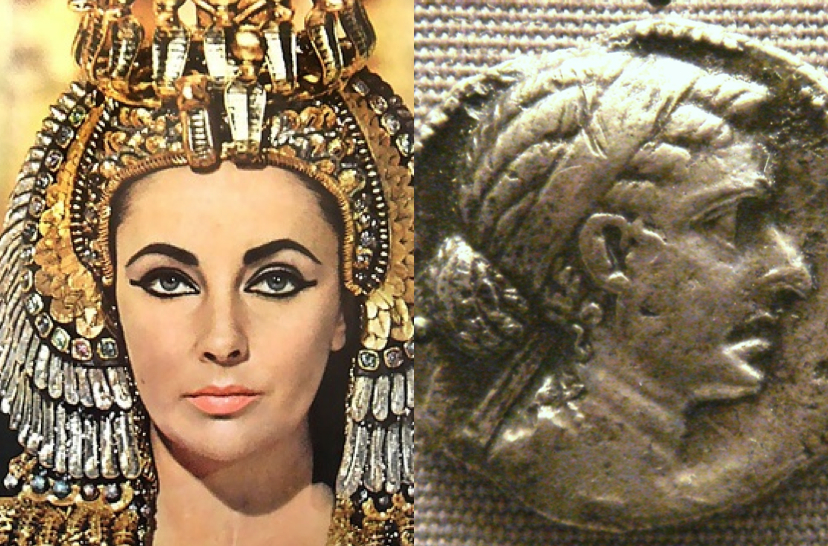
There are two prevailing beliefs about Cleopatra. The first is that she was a captivating beauty, so dazzling that she was able to snare two of the world’s most powerful men into her bed. The second is that she was an ugly, hook-nosed hag.

So which is the truth?

Despite, or perhaps because of, the spate of iconic portrayals of the Queen of the Nile as a ravishing seductress, Cleopatra’s detractors point to the coins that were issued during her reign as evidence of her hideous appearance. There were a number of coins issued during her reign and few of them are even remotely flattering. In fact, the one I’ve included in this post isn’t even the ugliest. But it must be noted that coins were intended to convey power and were a stylized art form. Mark Antony was said to be quite handsome and Augustus was described as a young Apollo and yet, they don’t always fare very well on all their coins either.

A more accurate way to gauge Cleopatra’s comeliness is to check out her marble busts, which were carved in a time of Roman dominance where realism trumped Hellenistic idealism in artistic renderings.


Busts of Cleopatra

The marble busts of Cleopatra do not reveal a ravishing beauty, but neither do they portray a hook-nosed hag. What we see is a reasonably attractive woman whose comeliness must shine through even in white marble without the color of a blush upon her cheek.

What about the literary evidence? Ancient historian Cassius Dio recounts that Cleopatra was “a woman of surpassing beauty,” and Plutarch tells us that Cleopatra was “a woman who was haughty and astonishingly proud in the matter of beauty.” However, a passage from Plutarch is often latched onto as evidence that the queen was anything but.

In Plutarch’s Life of Antony, he writes, “For her beauty, as we are told, was in itself not altogether incomparable, nor such as to strike those who saw her; but converse with her had an irresistible charm, and her presence, combined with the persuasiveness of her discourse and the character which was somehow diffused about her behaviour towards others, had something stimulating about it. There was sweetness also in the tones of her voice; and her tongue, like an instrument of many strings, she could readily turn to whatever language she pleased…”

This passage is often taken to support the argument that Cleopatra had the face of a troll, but it seems to me that Plutarch is giving us an honest assessment. Her beauty may not have been incomparable, but she did have some.