Join the Newsletter!
Latest Book
Categories
Community
Connect

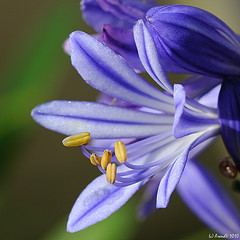
Agapanthus: The Real Lily of the Nile

One of the reasons I chose the title of Lily of the Nile for my debut novel about Cleopatra’s Daughter is because the Egyptian Lotus is actually a water lily. There are many myths about it, such as that it blossoms only at night–much like Selene, who is named after the moon and only allowed to show her true colors in darkness.

However, a true Lily of the Nile is the agapanthus, a bluish purple flower with yellow-tipped stamens. Though it isn’t a lily, it is native to South Africa. They grow on the banks of rivers and streams; they require plenty of water. They’re also summer flowers.

I’m thinking about planting some in my back yard!

Books About Cleopatra Selene

Cleopatra Selene was the sole survivor of the Ptolemaic dynasty that ruled Egypt for almost three hundred years. Taken prisoner after her parents committed suicide, she was only eleven years old when she was marched as a chained captive through the streets of Rome. That she survived these horrors to become one of the greatest queens in the empire is a story that should inspire everyone, but Cleopatra Selene is virtually unknown. Perhaps this is because she is entirely overshadowed by her more famous mother, but with a spate of books coming out about this most intriguing Egyptian princess, perhaps Selene will have her day in the sun.

The latest book about Cleopatra Selene is my own debut novel, entitled Lily of the Nile (Berkley Books, January 2011); I’m delighted to have the chance to compare and contrast the books that came before mine.

Selene is mentioned only briefly by the ancient historians. The first biography of her life appears to have been written by Beatrice Chanler in 1934. Chanler’s book might be seen by academics as altogether too speculative for a biography–it supposes motives and often jumps into the heads of others like a benign omniscient narrator. For a commercial fiction writer, however, it is immediately recognizable as historical fiction. I was powerfully influenced both by Chanler’s lofty prose and her theory that Selene was a religious figure for Isis worshippers. Her book has long-since been out of print and it’s quite difficult to come by a copy of it; my own is one of my most treasured possessions because it moved me so. In fact, one of the motivations for my own work was to update Chanler’s ideas and make them more accessible for modern readers.

In 1971, Alice Curtis Desmond wrote a book entitled Cleopatra’s Children which covers both the end of Cleopatra’s life and the fate of her children, including Cleopatra Selene. This book is more firmly in the tradition of historical fiction and takes a number of creative liberties. For example, like me, Desmond imagined Selene being directly involved in her mother’s suicide. Though many of its theories have been disproved and it’s an old book, I would recommend it for young readers because of its direct, simple style.

Nine years later, Andrea Ashton would write Cleopatra’s Daughter, a romantic epic of Selene’s life, totally in keeping with the tradition of Bertrice Small. The book is filled with melodramatic flourishes, but she’s the first of the authors to approach Selene’s life with any concern for the Berber peoples over which Selene would rule as Queen of Mauretania. Though there’s no evidence that Selene and her husband Juba II ever set foot in Numidia, and recent scholars suggest they did not, Ashton threads genuine concerns about native populations and imperialism through her romance. Oh, sure, she gives us a spunky cheetah-keeping, chariot-driving heroine who has constant misunderstandings with her husband before they can find their happy ending. But she also sketches out some of the genuine difficulties a modern audience might have about a grown man marrying a fifteen year old girl and explores the psychology of exiled royalty like Selene and Juba with remarkable sensitivity.

Most recently, Cleopatra Selene was memorialized by the acclaimed historical fiction writer, Michelle Moran. Moran’s book explores the famous people, trials, customs and architecture of Rome in the Augustan Age. She takes the liberty of imagining Selene as an architect and inventing an anti-slavery activist known as the Red Eagle to represent slave revolts of the age.  Whereas Michelle Moran applied an archaeological lens to her book, I embraced magical realism in my work and wanted to focus on the significance of the Augustan Age in the progress of women’s equality and spirituality.

This summer Vicky Alvear Schecter will publish Cleopatra’s Moon. I can’t wait to read it! And in the autumn, the second installment of my series about Selene, Song of the Nile, will hit bookshelves too. 2011 is clearly the year of Cleopatra Selene.

Trading Card for Lily of the Nile

I’ll be attending the Romantic Times convention in Los Angeles this April and a number of authors have decided to create a collection of romance trading cards. The effort is being spearheaded by the irrepressible Jeannie Lin, author of historical fiction set in Tang Dynasty China, and I appreciate the inclusion of women’s fiction as part of the collection.

Since Lily of the Nile qualifies, I’ve created some prototypes for the cards. I’m thinking that I might want to put the ISBN on the card, but perhaps there’s no need for it. They’re color-coded and the pewter frame in pink was chosen for women’s fiction, so I used that template. I keep feeling as if I should somehow bring some cohesion to the front of the card. Maybe the bubble should be pink so that it looks as if it somehow belongs in that frame. But I’ve probably already spent too much time on this project. Suggestions?


Upon further consideration, I decided to do a little revision.


The San Francisco Book Review Says…

“Stephanie Dray’s Lily of the Nile is a spectacular blend of history and unforgettable fiction…Lily of the Nile is a fresh and vibrant story of family, loyalty, political games, and love. It’s exquisitely written and left me begging for more. The only letdown was that it had to end.” ~ San Francisco Book Review

Also, a review from Read My Mind. This is the first review that validates my presence on twitter.

“The reader spends most of the time feeling Selene’s displacement, and her struggle to maintain herself, in the midst of a culture that seemingly does not value anything she has been brought up to cherish.” ~AliseOnLife

And a review from the lovely Lynn Spencer from All About Romance:

“The author’s vision of a very faraway time and place kept me reading. Cleopatra Selene is an intelligent narrator and watching her grow up and reinvent herself following the death of her parents and her own captivity in Rome makes for compelling reading.” ~Lynn Spencer of All About Romance

I particularly enjoyed this review because I felt like this reviewer really shared my passions and understood exactly what I was trying to accomplish:

“A stunning novel that looks at how important Cleopatra Selene was to history, how her Ptolemaic heritage would eventually shape her future kingdom of Mauretania, and a look at how the Isaic faith was the forerunner of Christianity…the blending of Isaic magic and actual history give Lily of the Nile a flavor that’s all its own and allows it to stand out amongst the other countless historical novels in the aisles of Barnes and Noble.” ~Amanda Ferris, CamelClutchBlog

And last, but certainly not least, the short and sweet…

“LILY OF THE NILE is so vivid and lyrical I felt like I was standing beside Princess Cleopatra Selene throughout her inspirational journey. Stephanie Dray’s historical debut is meticulously researched and sets the bar for Cleopatra novels.” ~Julie from That’s Swell!

Love, Monsters & Mythology Goes Upstate New York

I’ll be making a presentation in time for Valentine’s Day entitled Love, Monsters & Mythology. The handout for it is here. It’s worth looking at for the pretty pictures.