Join the Newsletter!
Latest Book
Categories
Community
Connect

How Did Cleopatra Really Die?

The story of Cleopatra’s death, as handed down to us by her conqueror, is that she killed herself by means of a poisonous snake. According to Suetonius, the stunned Octavian summoned snake charming Psylli to suck the poison from puncture wounds found on her arm. Later, she was depicted in a wax effigy during Octavian’s triumph with an asp clutched to her breast and contemporary poets like Virgil also alluded to the snake as the instrument of her death.

It could be that they were all wrong. As Plutarch eventually admits, no one knows the truth of how Cleopatra died. Strabo may have actually been in in Alexandria at the time of her death, and he suggests that she may have put poison at the end of a needle. But none of the ancients seem to have favored the idea that she gulped down a poisonous mixture in the form of a drink, so modern claims that there was no cobra and that she drank a poison concoction must be eyed with at least a little healthy skepticism.

It’s become fashionable to challenge the manner in which Cleopatra died and also to suggest that she may have been murdered or forced to suicide. It’s even theorized that Octavian sent Dolabella to the queen with an elaborate story about how she’d be dragged through the streets of Rome for the express purpose of convincing her that killing herself was the only way to preserve her dignity.

Adherents to these theories point out that Octavian was a master propagandist who wanted to be rid of the queen and was willing to lie about how she died so as to ensure that he’d be held blameless. However, it seems that historians ought to base their conclusions upon more than a belief that Octavian was a liar.

It may well be true that a living Cleopatra was an enormous inconvenience to Octavian. He was undoubtedly better off with her dead than alive. However, it’s equally true that there isn’t a single ancient source that accuses Octavian of having killed the queen or having encouraged her to kill herself. In fact, Plutarch tells us that Cleopatra was researching painless forms of suicide long before Octavian stepped foot in Alexandria and his information may have come from Cleopatra’s only living daughter, through Juba II. Moreover, we’re presented by an undisputed claim that when Cleopatra was first captured, she was already trying to kill herself with a knife. Even after she was disarmed by Gaius Proculeius, the queen thereupon stopped eating and allowed herself to succumb to illness until Octavian threatened her children. All of this happened before the much ballyhooed talk with Dolabella, and establishes a pattern of suicidal behavior.

Finally, there is the matter of Octavian trying to revive her. Certainly, Octavian was not above play-acting, but this would seem to fit the pattern of historical sources that tell us the queen’s death came as a surprise to him.

Like Plutarch, I’ll admit that no one knows the truth of how Cleopatra died. But the preponderance of the evidence still seems to be that she took her fate into her hands and ended her own life…quite possibly with the help of a venomous snake. And for purposes of a historical novelist, suicide by snake was good enough for Margaret George, so it’s good enough for me!

Beginnings

Now that I’ve drafted the sequel to LILY OF THE NILE, it’s time to go back, smooth it out, make each chapter do more. I’ve never been in the position of trying to make a sequel stand on its own as a stand-alone book, so the beginning has really been a challenge for me. I’ve written a few different beginnings, and I was hoping you might offer your perspective on which one works best for you:

#1 — Sorceress, Seductress, Schemer

Sorceress, seductress and schemer. As Cleopatra’s daughter, I confess, I’ve been all these things, and more. I’ve kept secrets, betrayed vows, and broken faith even with the goddess whose words carve themselves in my flesh. And though you may have never heard my name spoken with the slightest censure, it’s only because I took a lesson from my mother’s defeat to safeguard my reputation above all.

As a prisoner of war, I learned to beg for my life. As a princess held hostage in the confines of the emperor’s household, I learned to mask my emotions so that our captors would never see my grief or my contempt. On the Palatine Hill, where our heritage was reviled and our faith suspected, I learned that to deceive was to survive.

The emperor’s wife said that by sparing me, he allowed a viper into the very heart of Rome. But it was the emperor who molded me into a creature who could strike when provoked. As one of his favorites—as his most unlikely apprentice—I learned that to win back my mother’s lost Egypt, I must manipulate and beguile. For when I was fourteen years old, it was Augustus who took me by the arms and confessed that, in me, he wanted a Cleopatra of his own.

#2 — Childhood Things

It was time to burn all childish things, for it was the night before my wedding, and this was the Roman custom. But what was I to surrender to the flames? My childhood ended that hot Egyptian day at the end of the war, when I carried a basket of figs to my mother, inside of which was hidden the deadly serpent she would use to deliver her to the afterlife. All my toys, the keepsakes of a little princess, had all been looted or left behind when I became a prisoner of war.

I was almost fifteen now, and as I rifled through my room for some symbolic offering, I could find nothing I was willing to part with. Not the filthy, tattered dress that I wore as a shackled prisoner in the emperor’s triumph, when he dragged me through the streets behind his chariot. It was covered with the blood of a prince who had spoken in our favor, though it cost him his life. I had kept it, a gristly souvenir of what my brothers and I had survived and now it was all that remained of the Prince of Emesa. I wouldn’t burn it.

Neither would I surrender the jade frog amulet that dangled from a chain at my throat. It was the last thing my mother had given to me, gleaming with the remains of her magic, a token to remind me that she had given me her Egyptian soul—her ba. And though it was carved with the words ‘The Resurrection’, they had let me keep it, for even Roman children wore bullas as a ward against evil.

#3 — Augustus

Augustus. You will have heard of him. In this River of Time, the whole world has. His statues—an idealized version of him to be sure—are ubiquitous throughout the empire. A month of summer is named after him. He has been immortalized in Virgil’s Aeneid, the propaganda he commissioned to celebrate his reign. A whole generation has lived without knowing a time when he was not the master of the world.

But I remember when he was only Octavian. He was my mother’s worst enemy, my father’s false friend, and he murdered my brother Caesarion—who was, in a fashion, his brother too. You may think I hate him, but I would deny it, and not even I would know whether or not I lied. For everything I learned about the art of deception, I learned at the emperor’s knee. He took everything from me—even my faith—then unwittingly gave it back again. But that is to get ahead of the story.

#4 — My Wedding Day Dawned

My wedding day dawned rosy as the blush on a maiden’s cheek. I watched the sun peek between pink clouds, and knew that today, I must also shine for Rome. It was early yet in the emperor’s household; only the slaves were awake, bustling about the courtyard, trimming shrubbery and hanging lanterns. Too busy to notice me beneath the overripe fig tree.

I pulled myself up into the branches, leaning back so that the smooth bark was against my neck, then peered over the wall to survey Rome’s seven hills. All the vainglorious villas and middling monuments stretching to the Tiber River beyond. And as morning broke over the sprawling city of tiled roofs, I tried to see this day with my mother’s eyes.

She was Cleopatra, Pharaoh of Egypt, a woman of limitless aspiration. And I was her only daughter. She had wanted a royal marriage for me. She may have even hoped my wedding would be celebrated here in Rome. But could she have conceived that such a thing would come to me through her bitterest enemy? In her wildest dreams, could she have imagined that the same man who drove her to suicide—the same man who took me prisoner and dragged me behind his chariot just four years ago—would now make me a queen?

Yes, I thought. She could have imagined it. Perhaps she had even planned it.

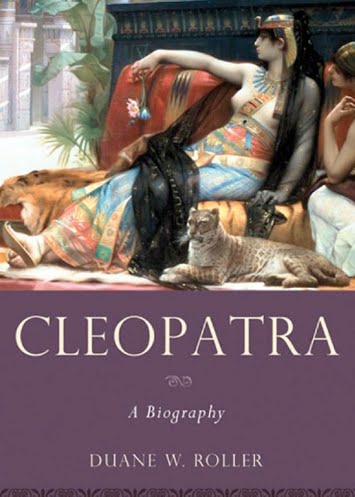
Review of Duane Roller’s New Cleopatra Biography

Today I’m guest blogging over on Clio’s Children, a blog for historical fiction authors. I’ve reviewed Duane Roller’s excellent new biography of Cleopatra and talked about some of the new stuff we’ve learned about the Queen of the Nile. Stop by and check it out!