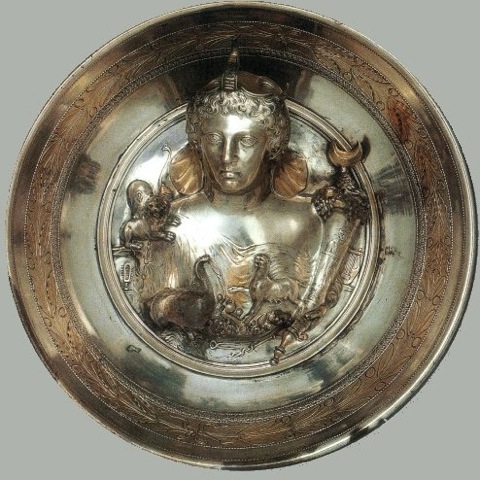
Discovered: Roman Basilica built on ruins of Ptolemaic temple
It’s a good time to be an archeologist in Egypt, especially since satellites have been helping out. This latest find might not seem important, but is directly relevant to the time period that Cleopatra Selene lived in. According to this article, the earliest ever Roman basilica has been unearthed outside Alexandria…and beneath it? One of the temples Strabo (a contemporary of Selene’s and good friend of Juba II’s) discussed in his writing. It’s always wonderful to confirm what the ancient historians wrote about and some of the relics discovered are in great condition!
I Discuss Cleopatra Selene with Chick History

This isn’t your typical promo interview. This is an NPR-style in-depth discussion of the life of Cleopatra Selene and Juba. Other than my hideous mispronunciations and my niggling fear that I wasn’t quite precise enough in some of my answers, I think it went extremely well and that even people who have read the novels will learn new things in this interview. Also, there’s a slide-show that accompanies the talk. Please let me know what you think!
Cleopatra and Patriotism
The English may perhaps be forgiven their belief that they invented patriotism because the term is said to have first been coined in the Elizabethan Era. However, patriotism as a personal feeling and political tool is something far older and embraced by no lesser personage than Cleopatra VII of Egypt.
The word patriotism itself finds its root from the Greek. Both the ancient Greeks and the Romans had a strong notion of attachment to their fellow citizens, to their cultural identities, and sometimes to their homelands. The Romans, in particular, made highly effective use of national honor to persuade their soldiers to shun personal battle glory in favor of collective might. On their rise to super power status in the ancient world the Roman Republic frequently called upon its citizenry not simply as clans and coalitions but by their collective identity as Romans.
Roman patriotism could also be turned to more sinister purposes and this lesson was probably not lost upon Cleopatra VII who took two Roman generals as lovers.
Because the famed Queen of the Nile has been so often misrepresented as a product of more ancient Egyptian tradition, depicted in full Pharaonic regalia as if she stepped out of a Middle Kingdom tomb, modern scholars trip over themselves to remind us all that she was primarily a Hellenistic queen. But Cleopatra VII was not only a Hellenistic queen; her relationship with Egypt and its native citizens was decidedly more complicated.
Because of the Ptolemaic practice of brother-sister marriage, historians can account for almost all of Cleopatra’s ancestors, pure-blooded Macedonians. However, Cleopatra’s mother is not known. Ptolemaic scholar Gunther Holbl has theorized that the queen may have descended, on her mother’s side, from an Egyptian priestly family. This theory has also been adopted by Professor Duane W. Roller who writes in his recent scholarly biography with the Oxford University Press, “Cleopatra VII, then, was perhaps three-quarters Macedonian and one-quarter Egyptian, and it was probably her half-Egyptian mother who instilled in her the knowledge and respect for Egyptian culture and civilization that had eluded her predecessor Ptolemies, including an ability to speak the Egyptian language.”
Whether she learned the language because it accounted for part of her heritage or simply because it was politically expedient, the fact remains that she was the first member of her dynasty to do so. Whereas her predecessors sometimes seem to have considered themselves as the rulers of Alexandria, Cleopatra took a more expansive view of her country. She traveled extensively in her kingdom and showed great respect to the indigenous religions. She funded temples of the native Egyptian goddess Hathor and attended the burial rites for the Apis Bull–something which would later be used against her in a propaganda war that attempted to present her as an exotic, foreign Oriental who worshipped beasts and dabbled in magic.
Certainly, Cleopatra’s official portraits–the ones she wanted to be seen internationally–depict a thoroughly Macedonian-Greek queen, with the symbolic diadem and melon coiffure. However, Cleopatra was a known lover of costumes. She’s noted for having dressed on occasion as an incarnation of Isis. Because Isis had been thoroughly embraced by the Greeks and equated with Aphrodite, this may not have been an Egyptian costume. On the other hand, Cleopatra may well have adopted native dress on special occasions to appeal to her subjects.
While one must view with skepticism all the propaganda leveled by her enemies portraying her as a sensualist and painted Egyptian whore, there was some degree of cultural fusion in Alexandria, and when not dressing to impress the international community of Greeks, Cleopatra may well have adopted some forms of native Egyptian adornment. For example, heavy black eye-liner and wigs were often adopted by non-native Egyptians for their practicality. Kohl was thought to protect eyes from disease and the effects of the sun. Wigs helped prevent the rampant spread of lice in the ancient world.
Whether or not the queen actually dressed in the traditional garb of Egypt, wearing the double-crown and carrying the crook and flail of a Pharaoh, is less important than the fact that she was not shy about being portrayed this way. This is why all the misleading iconography depicting Cleopatra as a sandy-skinned temptress wearing transparent linen is still relevant to any discussion of her. As numerous statues and carvings attest, Cleopatra sought to forge a bond with her countrymen as Egyptians on either side of the cultural divide. The best evidence for the queen’s patriotism is a remarkable action she took just prior to the war with Octavian.
For most of her life, the queen was known as Cleopatra VII Philopater to show respect and love for her father. But in the last years of her life she adopted the title of Philopatris in which she declared a love of her country. Michel Chauveau writes, “With this single word, she erased centuries of foreign occupation: It was no longer a right born of the Macedonian conquest that established her royalty over Egypt, but rather a strong attachment, a quasi-mystical bond with the land of the Nile and all who dwelled in it, whatever their origin.”
Cleopatra may have embraced patriotism as a political tool or these sentiments may have been entirely heartfelt. Because she lost the war, we will simply never know, but Roller’s biography of the queen suggests that Egypt was always foremost on her mind and that Romans ignored this at their peril.
Did Cleopatra Really Dissolve A Pearl and Drink It?
When Cleopatra was wooing Marc Antony, she bet him that she could spend a veritable fortune on a single meal. He doubted her. In response, she is said to have dissolved a valuable pearl in vinegar and gulped it down. But is the story true? No one knows for certain, but new research shows that it is not out of the realm of possibility. My favorite line in the article?
The cocktail would have been less appetizing than a martini with the traditional olive, but still palatable.
How Did Cleopatra Really Die?
The story of Cleopatra’s death, as handed down to us by her conqueror, is that she killed herself by means of a poisonous snake. According to Suetonius, the stunned Octavian summoned snake charming Psylli to suck the poison from puncture wounds found on her arm. Later, she was depicted in a wax effigy during Octavian’s triumph with an asp clutched to her breast and contemporary poets like Virgil also alluded to the snake as the instrument of her death.
It could be that they were all wrong. As Plutarch eventually admits, no one knows the truth of how Cleopatra died. Strabo may have actually been in in Alexandria at the time of her death, and he suggests that she may have put poison at the end of a needle. But none of the ancients seem to have favored the idea that she gulped down a poisonous mixture in the form of a drink, so modern claims that there was no cobra and that she drank a poison concoction must be eyed with at least a little healthy skepticism.
It’s become fashionable to challenge the manner in which Cleopatra died and also to suggest that she may have been murdered or forced to suicide. It’s even theorized that Octavian sent Dolabella to the queen with an elaborate story about how she’d be dragged through the streets of Rome for the express purpose of convincing her that killing herself was the only way to preserve her dignity.
Adherents to these theories point out that Octavian was a master propagandist who wanted to be rid of the queen and was willing to lie about how she died so as to ensure that he’d be held blameless. However, it seems that historians ought to base their conclusions upon more than a belief that Octavian was a liar.
It may well be true that a living Cleopatra was an enormous inconvenience to Octavian. He was undoubtedly better off with her dead than alive. However, it’s equally true that there isn’t a single ancient source that accuses Octavian of having killed the queen or having encouraged her to kill herself. In fact, Plutarch tells us that Cleopatra was researching painless forms of suicide long before Octavian stepped foot in Alexandria and his information may have come from Cleopatra’s only living daughter, through Juba II. Moreover, we’re presented by an undisputed claim that when Cleopatra was first captured, she was already trying to kill herself with a knife. Even after she was disarmed by Gaius Proculeius, the queen thereupon stopped eating and allowed herself to succumb to illness until Octavian threatened her children. All of this happened before the much ballyhooed talk with Dolabella, and establishes a pattern of suicidal behavior.
Finally, there is the matter of Octavian trying to revive her. Certainly, Octavian was not above play-acting, but this would seem to fit the pattern of historical sources that tell us the queen’s death came as a surprise to him.
Like Plutarch, I’ll admit that no one knows the truth of how Cleopatra died. But the preponderance of the evidence still seems to be that she took her fate into her hands and ended her own life…quite possibly with the help of a venomous snake. And for purposes of a historical novelist, suicide by snake was good enough for Margaret George, so it’s good enough for me!