Join the Newsletter!
Latest Book
Categories
Community
Connect

2000 Years Later & Homs (aka Emesa) is in the News Again

I’m an American.

My country is only a few hundred years old.

My countrymen can be insular; even with jet planes the rest of the world seems very far away. And so, when we hear that a tank was captured by rebel forces in Homs it may not register as part of our collective experience. In that, I’m different because I spend all my days writing about the world of Cleopatra’s daughter.

Modern day Homs is the ancient kingdom of Emesa–an integral part of Selene’s parents’ plans for world domination and the place, ultimately, where Cleopatra’s legacy may have been preserved.

The Emesans were extremely religious, their city sacred to a sun god. The royal family of Emesa were priests of that cult. Emesa was a wealthy port city with rich soil perfect for the cultivation of important crops like wheat and olives. It was loyal to Rome and a strategic ally, unfortunately caught up as a pawn in the Roman civil wars.

Two royal brothers split their loyalties between Octavian and Antony. After the Battle of Actium, Prince Alexander (Alexio I) of Emesa was taken captive and marched beside Cleopatra Selene and her brothers in Octavian’s triumph, after which he was executed. In my novel, Lily of the Nile, this is a dramatic moment that affected Selene deeply and would help create a lifelong connection between her and the Emesan royals.

I chose to write it this way because if the line of Cleopatra lasted beyond the death of her grandchildren, it was here, in the kingdom of Emesa where Drusilla of Mauretania (Cleopatra Selene’s granddaughter) is thought to have married into the royal line. Later, another famously powerful queen, Zenobia of Palmyra, would claim to be descended from Cleopatra and if her claim is to be given any credence, it would be through this connection to the Kingdom of Emesa.

Homs is a special city for more reasons than I could list here and so my heart aches to see it as the center of violence in the news today; but if it becomes the place where a successful rebellion is staged in which the lives of women are ultimately improved, I cannot help but think Cleopatra and her daughter might smile just a little bit.

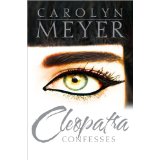
Cleopatra Confesses, by Carolyn Meyer

Most novels about Cleopatra focus on the tumultuous events of her adult life–the love affairs, the heart-break, the warfare, and ultimately, her tragic failure. This new novel by historical fiction author Carolyn Meyer zeroes in on Cleopatra’s early life, the unlikely journey of a third-born daughter whose rivalry with her siblings was nothing short of a deadly power struggle.

The book’s creator, CAROLYN MEYER, is the celebrated author of more than fifty books for young people, many of which have received awards and honors. She lives with her husband in Albuquerque, New Mexico. She’s also agreed to stop by and answer some questions here today.


Picture of Cleopatra Confesses Book CoverWhy Cleopatra?

I’ve written a number of novels about various queens of Europe–the Tudors, Catherine de’ Medici, Marie Antoinette, and (coming soon) Mary, Queen of Scots–and I was ready to try something completely different. Cleopatra immediately came to mind, and I was  fascinated, because–despite her great fame–so little is actually known about her.

What does she really have to confess?

Her relationships with her sisters and brothers  were shockingly confession-worthy.

What can young people learn from the Queen of Kings?

That being a queen is not a glamour job. And then there’s always somebody lurking nearby who wants to do you in.

Do you think she really loved either of her Roman consorts or were these affairs of political convenience?

I believe she was drawn to these powerful men on every level–physical, emotional, intellectual. For her, that equalled love. I don’t think she had other lovers, although her lovers certainly did–and wives, too.

Where do you come down on the question of how she died? Was it murder? Poison? Serpenticide?

I’ve read that being bitten by an asp/cobra is an extraordinarily painful and inefficient way to die, but that’s part of the Cleopatra legend, and so I’m sticking with it.

(Interviewer’s Note: I made the same choice for Lily of the Nile: A Novel of Cleopatra’s Daughter, and for the same reason, as explained in my article, How Did Cleopatra Really Die?)

What was the most surprising or confusing thing you learned about Cleopatra while writing this book?

One of the great mysteries surrounding Cleopatra is her physical appearance. The legend, again, paints her as exotically and erotically beautiful, but the only contemporary image, on a coin, shows her as hawk-nosed with a fat neck. My gut-feeling is that she was one of those women who are so fascinating that their actual physical appearance is irrelevant. I finally concluded that she was nothing like Elizabeth Taylor, was in fact quite ordinary looking but with great charisma and charm.

(Interviewer’s Note: In my article Was Cleopatra Ugly? I  argued that she was probably neither a raving beauty nor an ugly old hag, so an ordinary person with great charisma sounds right to me.)

Picture of Carolyn Meyers

Historical Fiction Author Carolyn Meyer

Your thoughts on Octavian?

I try NOT to think about Octavian, but he must have had something going for him that convinced Caesar to make him his heir.

It’s difficult to give Octavian his due when you find yourself identifying with Cleopatra, I admit. I think he was a brilliant leader, but I’d have preferred it if Cleopatra won that battle. What legacy do you think Cleopatra left for her children–especially Cleopatra Selene?

I know very little about Selene. That’s your department.

What trends have you noticed in Cleopatra fiction lately? Has the Queen of the Nile inspired Egyptomania again after all these years?

I really don’t know how to account for it. The recent appearance of all sorts of novels about Cleopatra, and now her daughter, began long after I had begun working on my book. Or at least I hadn’t noticed them.


I’d like to thank Carolyn for stopping by and encourage my readers and Cleopatraphiles to pick up this wonderful book!

The Chronead and the World of Nyki Blatchley

Because I like to keep current on all things Cleopatra in the fiction world, I was interested to learn more about Nyki Blatchley’s latest short story, The Chronead, which will appear in Dark Valentine Literary Magazine.  Like me, Nyki wonders how the world might have been different if Cleopatra had won her struggle with Octavian. Nyki has been kind enough to stop by and tell us about his work, so I hope you’ll make him feel welcome!

Nyki Blatchley is a fantasy author and poet.  He’s performed his poetry with his own musical backing in many venues in London and elsewhere. Since the late 90s, about two dozen stories have been published in a variety of magazines, webzines and anthologies.  He graduated from the University of Keele in English and Greek Studies, and has worked in various jobs, from bookseller to artist’s model.  He currently lives just outside London.  Interests include (in no particular order) reading, folk music, history (any period, but especially classical Greece and medieval Europe), Doctor Who, cricket (as a viewer only), rock music, historical re-enactment, astronomy, and acquiring general knowledge.


I’ve been making up stories for as long as I remember, and I first starting writing them down when I was four.  I know that, because I still have the ones I wrote then.  I never really thought much about “being a writer” while I was a kid, because it was just something I did, as natural as eating or drinking, although I did consider myself “a poet” when I was in my teens.

It was only really in my twenties I started taking writing fiction seriously, and I’ve been writing continuously ever since, gradually improving.  I’ve had a novel published by StoneGarden in 2009 called At An Uncertain Hour, a fantasy novel covering three thousand years of an immortal’s life.  I’ve also had a novella, The City of Ferrid, published by Crystal Codices.  That’s also a fantasy, set in the same world, but in a Victorian-style era.  A couple of dozen of my short stories have also been published, many of them set in the same fantasy world, and I’m working on a fantasy trilogy called The Winter Legend at the moment.

I’ve been fascinated with ancient Greece since my early teens.  Before that, it was medieval Europe and King Arthur (both of which I still love) but the classical world gradually took over.  I don’t remember any specific turning-point, but I think reading Roger Lancelyn Green’s retellings of the Greek myths had something to do with them.  I’d still recommend them for children, though I soon graduated onto Mary Renault’s historical novels, which I’ve always loved.

Illustration for the Chronead by Joanne Renaud

Illustration for the Chronead by the fabulous Joanne Renaud

I learnt Greek privately, as it wasn’t offered at my school, and I went to Keele University, taking Greek Studies and English.  The Greek Studies course was a broad one – besides language and literature, we studied the philosophy, art, science and religion from all periods – and history, from pre-Mycenaean to classical influences on modern Greece.

I was particularly fascinated by the Ptolemies, the Macedonian dynasty that ruled Egypt for three centuries and finished in a blaze of glory with Cleopatra.  Of course, the famous Cleopatra (half the female members of the dynasty had that name) has captivated people for two thousand years, and it’s not hard to understand why, but my personal favourite was always Arsinoe Philopater, Cleopatra’s great-great-great grandmother (with an extra great if you go by a different route).  She was an extraordinary woman who lived in times as vibrant and murderous as any under the early Caesars, and she seems to have been widely loved.  Eratosthenes, the first scientist to accurately measure the earth, was a great admirer of her, for instance.  I’ve had a vague back-burner project for many years to write her story, perhaps in a format a little like I, Claudius, but I’ve never quite got around to it yet.

Chronead, the story I have due in Dark Valentine, is partly pure fun, but also combines the concept of “chroneads” (nymphs of time) with one of the great what-ifs of history – what if Cleopatra had emerged victorious over Octavian?  Would we be looking back to the Ptolemaic Empire ruling the world, instead of the Roman Empire?  And just how much would that change the history we know?  I greatly enjoyed writing it, and I think there might be room for writing more about chroneads.

Besides Chronead, I have stories due out in Icarus and Golden Visions over the summer, and Aoife’s Kiss in the autumn.  And I’m submitting all the time, so watch this space.

http://www.nykiblatchley.co.uk/

Did Augustus Really Persecute Isis Worship?


Statue of Isis, taken by Steph Adamo

A common misconception held even by some classics majors who ought to know better is that Rome was tolerant of every foreign god and the idea that Augustus suppressed Isis worship is a fictional literary flourish.

While it’s true that Rome generally accorded respect to foreign gods, there are a few religions that fell afoul of the powers-that-be. Rome virtually exterminated the Druids. They burned Christians and fed them to the lions. And we learn from TertullianCassius Dio, Valerius Maximus, Josephus and others, they cracked down on Isis worship too.

The female-centric Alexandrine cult promoted unorthodox ideas about gender roles, war and slavery; it was thought to be a threat to the moral fiber of Rome. Writers like Juvenal and Cattullus propagated the idea that the religion was obscene and orgiastic. Certainly, Isis was a favorite amongst prostitutes, which couldn’t have earned her any points with the musty old conscript fathers in Rome.

Valerius Maximus tells us that the authorities attempted to purge the cult from Rome, going so far as to destroy her temples–though none of the workmen would take up an axe so the politician in charge had to remove his toga and start trashing the temple himself. Isis enjoyed a brief reprieve under Julius Caesar and Mark Antony–which may have had something to do with the fact that both men were sleeping with Cleopatra VII of Egypt, the New Isis.

After Cleopatra’s defeat, however, Octavian took up the mantle of protecting the moral fiber of Rome from Isis worship which, he apparently believed, subverted the proper relations of the sexes. That is to say, he didn’t believe that women should think themselves equal to men, and said so. At first he banned the worship of Isis within the sacred boundary of Rome–an indication of its status as un-Roman. However, while Augustus was away in 21 BC, his second-in-command, Agrippa, pushed the Isiacs out of the city entirely and forbid worship within a mile of Rome.

It should be pointed out that while Augustus set about destroying the Temples of Isis in Rome, he allowed himself to be portrayed making offers to Isis in traditional style on temples in Egypt. But that was Egypt, where he wanted to claim the power of the Pharaohs and make a seamless transition in rule. It’s also not clear that all these carvings were made at his direction, or on his behalf by well-meaning priests eager to curry his favor. Moreover, the appearance of Isis in frescoes and artwork on the Palatine should not be taken as an endorsement of the goddess. In the aftermath of Cleopatra’s defeat, Egyptomania took hold and it became the fashion to decorate gardens with obelisks and sphinx statues, regardless of their religious significance. That Julia, the daughter of Augustus, may have been an Isis worshipper is an interesting possibility that leads one to wonder if it was an honest spiritual calling or one more rebellion against her overbearing father.

The official Roman antipathy for Isis lasted after Augustus’ death. Josephus tells us that after a scandal during his reign, Tiberius (who was Augustus’ successor and Julia’s husband) crucified Isiac priests and threw a cult statue of Isis into the Tiber.

Much of this happened during Cleopatra Selene’s lifetime. That she continued to promote the worship of Isis in spite of this official antipathy for her goddess is an interesting facet of her life considering she would have been the most prominent Isis worshipper and a nominal member of the imperial family. It would be her nephew, Caligula, who would restore Isis worship in Rome where it would eventually flourish until the rise of Christianity.

Hollywood Depictions of Cleopatra

She is a timeless icon of femininity and feminism. She is the most famous woman in the history of the world–perhaps because she was, and remains, the most powerful woman in the history of the world. No subsequent queen or prime minister or secretary of state has ever had the geographic dominion, relative wealth, and unfettered authority that was enjoyed by Cleopatra VII of Egypt.

Almost everything we know about her has been filtered through the propaganda of her enemies. What remains are the scant facts and what we can deduce from them. She was a woman of extraordinary charm who shared a bed with not one, but two of the most powerful men in the ancient world–Julius Caesar and Marcus Antonius. She would become mortal enemies with a third–Octavian, otherwise known as Augustus Caesar–who did more to immortalize her than her lovers.

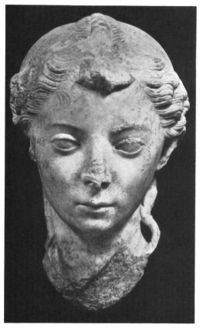
But she comes down to us through the ages without a face. Her coins–many of which depict her in quite severe and haggish ways–are stylized portraits, meant to impart terror rather than admiration. The few busts that we believe portray the Egyptian queen cannot be verified. There are no extant portraits nor textual descriptions of her. Because of this, artists have a blank canvass upon which they can imagine this cunning political queen in any way they like. That is a siren’s call to Hollywood who has made several attempts at bringing Cleopatra to life.

First, there was the silent film starring Theda Bara which was destroyed because it was too racy!

In 1934, Claudette Colbert starred in a Cecil B. DeMille production about the Queen of the Nile. The production is old-fashioned, in black and white, but the dialog is often fun. This is an Egyptianized version of the queen, which is not necessarily entirely inaccurate, but there is little visual reference to her cultural heritage as a Hellene. I especially like the invention of Herod making trouble between Cleopatra and Antony–which is unlikely to have happened the way it plays out on screen, but hints at the genuine trouble between the two client monarchs! There’s a certain jaded maturity that Claudette Colbert brings to the role, but the entire picture seems too small to incorporate such a big historical figure.

Another version was made with Vivian Leigh, but I’ve yet to see it (shame on me!), so I’ll just skip ahead!
Almost thirty years after the Claudette Colbert version, Hollywood had another go at it, this time creating a budget-busting visual extravaganza that would give the world its most iconic images of Cleopatra in the person of violet-eyed actress, Liz Taylor. The movie is a huge, splashy, melodrama that bankrupted the studio, launched careers and destroyed the marriages of its co-stars because its the film on which Richard Burton and Liz Taylor fell in love. Their sexual chemistry burns up the screen, their personal lives echoing those of the characters they played. One cannot watch without feeling the tiniest bit voyeuristic, and the authenticity of their connection make what might otherwise be a schmaltzy production into something emotionally gripping.


This is not to say that the film is all eye-candy and soap-opera. The costuming and set-decor is an interesting mix of Egyptian, Roman and Greek–all of this in keeping with accounts we have of Alexandria where cultural fusion was the norm. Though the film never mentions Cleopatra’s children by Antony–including the heroine of my own debut novel, Cleopatra Selene–it’s fairly historically accurate; viewers will learn from this film as well as be entertained. Not much better can be said for Hollywood than that!

Perhaps with an eye to how difficult it would be to top the 1963 Elizabeth Taylor version, Cleopatra has appeared primarily on the small screen ever since. The 1999 Television Mini-Series starring Billy Zane, Timothy Dalton and Leonor Varela was based on Margaret George’s excellent novel, Memoirs of Cleopatra. Unfortunately, the series bears little resemblance to the book. In this version, Cleopatra is a foot-stomping, whining, little brat who never brings any gravitas to the screen. Alexandria is rendered similarly unimpressive. While Varela’s looks may be more in line with the historical Cleopatra–her profile looks like the coins–her acting is fairly atrocious. It’s actually Billy Zane’s boyish rendition of Marcus Antonius that is the most convincing.

Which brings us to the latest incarnation of Cleopatra, Lyndsey Marshal’s version on HBO’s Rome. While I can find nothing bad to say about the series as a whole, which was masterfully written, funny, absorbing and dramatic–our Egyptian queen got the short end of the stick. Here she’s portrayed as a drug-addled slut who deceives Caesar about the parentage of her son. There’s nothing in the historical record to suggest this, other than Augustus’ accusations against her, but not every portrayal can resuscitate the queen’s image. Marshal brings a little bit of cunning to the role and never lets us forget that Cleopatra is without moral scruple–in that, she may be the closest portrayal to the historical woman.

It’s impossible to tire of Cleopatra and Hollywood seems poised to make another attempt. Given the run-away success of Stacy Schiff’s recent biography, a new movie is being planned starring Angelina Jolie. Reportedly, this film will focus more on Cleopatra as a mother and strategist. It remains to be seen what sort of images will leave their mark in popular culture this time!