So-Called Barbaric Nomads & Troublemakers on the Edge of the Roman Empire
To the ancient Romans, just about everyone was a barbarian. (Except the Greeks, who gave them the word in the first place, not to mention an inferiority complex to go with it.) Whether it was Blue Picts of Scotland or Gallic and Germanic hordes, the Romans generally dehumanized those they made war upon. Such was the case with the native North Africans–the Berbers–who lived in the land Cleopatra Selene and her husband Juba II were sent to rule.
A number of Berber peoples put up a fight. Jugurtha, Juba I, Tacfarinas–all these Berber warriors made a lot of trouble for the Romans. Especially Tacfarinas, who instigated full-scale rebellion after the death of Cleopatra Selene. However, one of the most interesting Berber-Roman wars was the one led by Lucius Cornelius Balbus against the Garamantes. I mention this war in my novel, Song of the Nile.
When I wrote about this conflict, I was at a disadvantage, as we know very little about the Garamantes. Like most of Berber culture before the spread of Islam, their civilization is lost to us. Or at least…it was lost to us. S.L. Stevens recently brought to my attention ground-breaking archeology that could change everything we know, or thought we know, about these “barbaric nomads and troublemakers on the edge of the Roman empire.”
Satellite imagery of Libya suggests that there are castles in the sand…fortifications and cities and artwork. The remains of a highly civilized people. I’m so excited about this! If you are too, I hope you’ll recommend it on Stumble Upon:
Photos of Cleopatra Selene’s Lost World
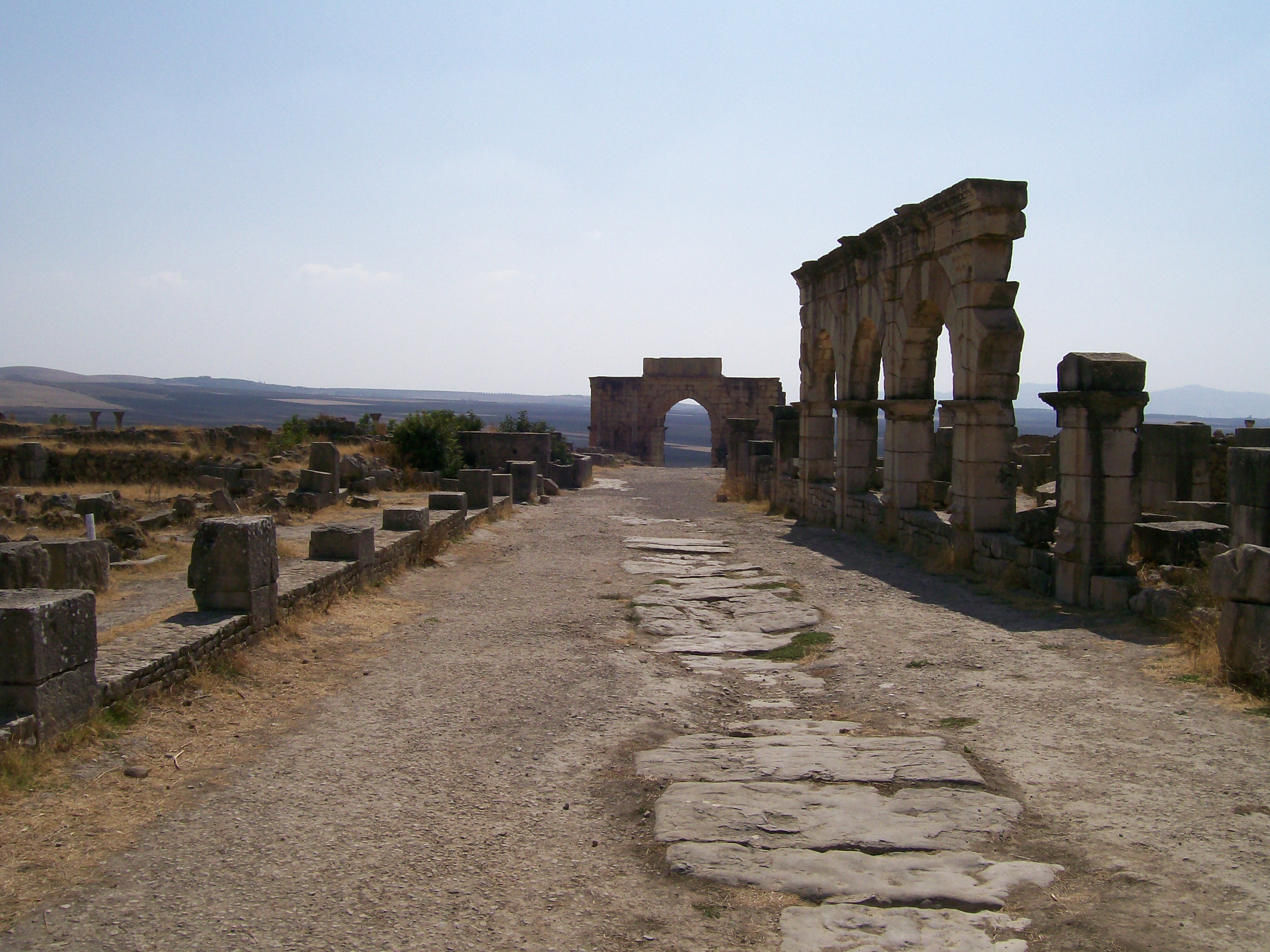
The ancient kingdom of Mauretania, once ruled by Juba II and Cleopatra Selene, is lost to the sands of time. But there are the ruins. I’ve posted photos of the area near Selene’s capital city, Iol-Caesaria, modern-day Cherchell Algeria. Now, thanks to Aaron Sakulich, I have the opportunity to share some images of the other major city of Mauretania: Volubilis. I’m amazed at the majesty these ruins hint at. I can imagine Selene riding a carriage along this road, passing under the triumphal arch, and walking in the shade of these columned avenues. I can see her feet sweeping along these mosaics, or climbing these stairs. Let’s take a little journey back in time.


How Rain, Grain & Cleopatra’s Daughter fed the Roman Empire
For much of its history, Rome depended upon Egypt for grain. While the Romans considered themselves an agricultural nation, and paid great homage to farming in literature, poetry, and art, the simple truth was that they couldn’t feed themselves.
By the time Cleopatra rolled herself out of a carpet at Julius Caesar’s feet, Egyptian exports accounted for fully a third of the 16.8 million bushels of grain brought to Rome. In short, whoever controlled Egypt could starve the world, which is why it was so important to warring Roman Generals.
However, by the time Augustus Caesar conquered Egypt, the needs of the Roman empire had far outstripped even the grain that Egypt could produce. (And some might argue that with a conquered Queen Cleopatra having committed suicide, there wasn’t anyone competent enough at the helm to turn Egypt into the bigger bread-basket it needed to be.)
That meant that Rome’s first emperor had to find a new way to feed his people, and he had to find it fast. He found a partial solution in Cleopatra’s daughter.
Though she’d been captured as a prisoner of war at the age of nine and marched through the streets in chains, the orphaned Cleopatra Selene was taken in by the emperor’s sister, Octavia, and became one of the favorites in the emperor’s household. At the age of fourteen, she was too dangerous to be married off to a fellow Roman who might take up the mantle of the Antonians. She was also far too dangerous to send back to Egypt where she might be immediately hailed as queen the moment her foot touched the shore.
The wily emperor had other plans for her.
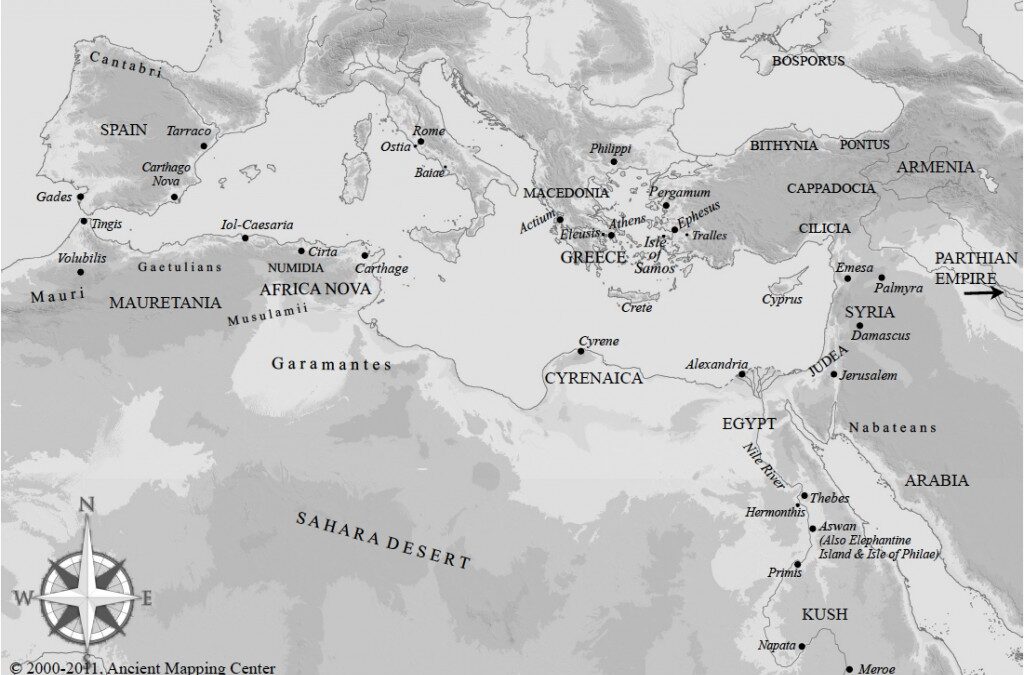
He married her off to Juba II, an orphaned Numidian princeling and sent the couple to North Africa to rule over the Kingdom of Mauretania (modern day Morocco, Tunisia & Algeria).
It made good sense to send Cleopatra Selene to the western frontier of the empire. For one, it got her out of Rome, where her father’s old partisans might use her to stir up trouble. Mauretania was also far away from Selene’s native Egypt, where she might be tempted by her mother’s old allies into rebellion against the emperor.
But beyond political reasons, it made good sense to send Cleopatra Selene to Mauretania because the country was thought to be an untapped resource. Though the kingdom was considered still wild and barbarous, the emperor believed it could be turned into a sea of grain-fields that would help sustain his empire–if only the right people were put in charge of it.
This is where Cleopatra Selene was instrumental. As the last Ptolemaic queen anywhere in the world, her name carried with it a certain prestige. Though Hellenistic rulers were monarchs, they aimed to rule through a concept of harmonia–an idea adopted by Alexander the Great that the conquered and the conquering peoples should mingle and show respect for one another’s ways.
It may have been believed that Selene would soften the blow to the natives in having to be ruled by a thoroughly Romanized king like Juba II.
Moreover, Cleopatra Selene was closely linked with the goddess Isis and appears to have been a proponent of her faith even when it wasn’t politically expedient to do so. Isis was the great mother goddess, linked inextricably with the production of grain. Selene adopted Isis as her patron goddess, promoted her on the coins of the realm, and built a giant Iseum in Mauretania.
Pastures were divided up, distributed to Roman veterans and other land owners, and put to the plow. But the task of turning her new kingdom into a grain factory wasn’t easy. Unlike the Egypt of her birth, Mauretania had no central river like the Nile to flood the farm lands with fertile black soil. Farming in ancient Mauretania, then as now, depended on the rain.
First, the autumn rains were necessary to soften the soil for farming. Crops weren’t harvested in the autumn but sown then. Next, a spectacular springtime rainy season was necessary to help the sprouted plants grow big and verdant in time for a summer harvest. (Of course, the climate of this area was probably a little different in the ancient world then than it is now, and the Julian calendar was relatively recently adopted in ancient Mauretania, so it’s impossible to say exactly when the growing seasons were. However, in modern times, wheat is harvested there from May to August.)
Once the summer harvest was in, it was a race to get the grain loaded onto ships to Rome. The winter seas were a perilous crossing to attempt, so the bulk of grain transport ships would want to set sail before November. (See: The Grain Market in the Roman Empire, by Paul Erdkamp.) This was problematic for Cleopatra Selene and her husband Juba, because the harbor they inherited needed to be improved.
In addition to logistical difficulties were the human conflicts. Rome was a colonial power and the new order Cleopatra Selene and Juba II were sent to impose disrupted the normal way of life for the native Berbers who lived in their kingdom. Roman landowners insisted on fencing in their plantations, refusing summer grazing rights to the Berbers who had used the plateaus of Africa to feed their flocks. This loss drove shepherds and other nomadic Berbers farther to the south, towards the desert, and impoverished their lives.
While Selene was alive, the tensions seemed to be balanced and under control. Perhaps she fostered that sense of Hellenized harmonia, because though the Romans in Africa Nova provoked a war with the native Garamante tribes, the Berbers in Mauretania seem to have been largely pacified.
All of this changed, of course, after Selene’s death. Facing ever more encroachment from farmers, Berber tribesmen eventually banded together in rebellion against both Rome and against the King of Mauretania. Their leader was Tacfarinas, and the war would go on for ten years.
Ultimately, the need for grain won out. And in conjunction with the province of Africa Nova, Mauretania would help provide enough food to feed Rome for eight months of the year–Egypt accounting for the other four.
Why Historical Fiction & Fantasy Go Together (You Got Your Chocolate in my Peanut Butter!)
Written in the tradition of Marion Zimmer Bradley’s Mists of Avalon series, my novels about Cleopatra’s daughter envision a young messianic queen whose goddess communicates with her in bloody hieroglyphic messages that scroll down her arms. The books have been blessed with great reviews and strong sales. (Here’s where I knock on wood that the trend continues.) However, a few readers have reacted with horror to the appearance of magical realism in a story based on the true life of a historical queen like Cleopatra Selene. One reviewer even said that my publisher ought to be ashamed for allowing me to mix fantasy with historical women’s fiction.
I suppose the argument is that I’ve allowed fantasy to corrupt the pureness and sanctity of history.
Now, perhaps it’s just my background as a student of law and government that informs my beliefs, but history has never seemed all that pure or sanctified to me. We know that history is written by the victors, for example. That is true whether the victory has been on the battlefield, in an election, or in the court of public opinion. The picture that comes down to us through history–especially ancient history–is largely incomplete. Documents have been lost. Motives are murky. (Heck, even with the benefit of a 24-hour news cycle, few Americans can agree on the history that we’re making right now!)
Consequently, I’ve always viewed history as an exercise and art in perspective. It’s always a story shaped by both the beliefs of the people who lived it and the beliefs of those reading about it now. A historical world, in my opinion, has a great deal in common with a fantasy world. It is just as foreign to us, and just as mystical, even with the aid of scholars.
I chose to include a touch of fantasy in my historical fiction for a few reasons. The first is that Cleopatra Selene’s story of survival and triumph is so unlikely, that it almost seemed to require magic as an explanation. Moreover, when writing about a deeply religious ancient queen, it seemed like a natural choice to adopt the world view of the people she came from.
In the ancient world, there were certainly cynics, but by and large, the people believed deeply in supernatural phenomenon. This is especially so for the Romans, who believed they could read the will of the gods in the flight of birds or from the entrails of dead animals. Magic was a real part of their lives. It played a big part in their politics. (Just a few years after my heroine’s death, the imperial family would fall into a kind of civil war after accusations that Germanicus was killed by witchcraft.)
Magical realism was a way of lending authenticity to the novel.
In most respects, the story of Song of the Nile, which follows Cleopatra Selene’s life as a young queen, striving to make a place for herself in a Roman world, stays very close to actual historical events. There is also, however, a stronger surge of magical power in this book–magic that derives from the divine feminine and Selene’s goddess worship–power that she uses to survive and thrive.
Of course, I’m not going to say that including magical realism in historical fiction was an easy task. Trying to weave together all the intricacies of actual history with the magic that I invented made me pull my hair out more than once. But I think the result has been a story that engages the spirit and the mind.
I’m certainly not the only author to do it, but sometimes historical fantasy seems to be the white elephant in the room that nobody talks about. Philippa Gregory toys with it in The White Queen & The Red Queen as well as her first novel, Wideacre. Judith Tarr uses it to great effect in the Throne of Isis. Margaret George certainly seems to “go there” in Mary, Called Magdalene. More interesting, perhaps, is the trend in the fantasy genre to start incorporating history. I was very impressed by Maria Davahna Headley’s Queen of Kings, which is a story that envisions Cleopatra as a kind of ancient monster.
So what are your thoughts on the matter? Does historical fiction and fantasy mix or should these streams never be crossed? Are there shades of magical realism in historical fiction that you enjoy?
On Historical Accuracy (And Whether It Matters)
These days, the quickest way to start an internet pie fight is to bring up the subject of historical accuracy in fiction. The discussion almost inevitably breaks down into arguments about personal preference that masquerade as objective tenets of literary faith.
Certainly, I don’t have the hubris to believe I can solve the matter with a single blog post, but I feel compelled to weigh in. However, this is less of a coherent essay or presentation of an argument than it is an exercise in clarifying my own thoughts through a dialog with fellow lovers of historical fiction.
To that end, it’s helpful to identify the parties to the argument.
First, we have the readers and writers who believe historical fiction should not veer from the historical record for any purpose. I won’t call them purists, because that carries with it a value judgment, so I’ll call them chroniclers. They value fiction that won’t lead them to believe false things about history or force them to look things up to make sure it’s true. In a sense, they want their historical fiction to be a personalized and more intimate form of the biography. (More on that later.)
Another party to the dispute are a group that I’ll call the fantasists. They are the writers who use or abuse history to any purpose, and the readers who love them for it. You might have alternate history, like Harry Turtledove’s which imagines an entirely different world outcome if some key event changed. You have historical figures changed into vampires, like Janet Mullany’s Jane Austen or Maria Davahna Headley’s Cleopatra. You have Marion Zimmer Bradley and Diana Paxson turning legend into a type of pseudo-history in Mists of Avalon series and then there’s Guy Gavriel Kay, turning actual history into fantasy. Some of these stories hew very closely to history and some of them are so wild and wooly that anything obviously goes. In some sense, novels at this extreme end of the spectrum are immune from criticism because they go so wrong that they’re right.
When stories fail on the grounds of “historical inaccuracy” it’s usually because the work fails to meet either the allegedly “high” standards of the chroniclers, or, conversely, fail to be clever enough to earn a pass. In short, the errors of historical fact seem to be unintentional, unacknowledged, or without purpose, literary or otherwise. Readers will forgive a lot as long as the work isn’t sloppy.
But what to do about all the fiction in the middle of the spectrum that offends one kind of reader or the other?
On the one hand, I value historical fiction that doesn’t gloss over the grim realities of the past in order to avoid accusations of glorifying sexism, racism or discrimination. I’m frustrated by critiques of literature that focus on the surface unpleasantness while failing to examine the subtext below. In my opinion, the best books are those that make a reader feel uncomfortable and cause him or her to examine assumptions. That’s one of the reasons I read and write historical fiction, which has a great capacity to educate, to illuminate, and to inspire. So, when chroniclers cry, “Your criticism is invalid because it’s historically accurate” they are defending the inherent value in holding up a mirror either to the past, or to the present. They don’t think it should matter that the reader’s sensibilities have been bruised, because they see an overwhelming social value in the pummeling. I sympathize with that sentiment.
On the other hand, I’m of the firm belief that historical fiction isn’t fiber; it doesn’t have to be good for you. I don’t believe in berating readers for enjoying insufficiently pure works of art, such as Braveheart or The Other Boleyn Girl. I’m frustrated with critiques of literature that overlook superlative storytelling, myth-shaping, or even fun-romps because the work is deemed to be insufficiently weighty. (As if all historical fiction must be anchored with tedious historical detail and cannot be shaken from the moorings of fact–even to keep the reader from being bored silly.) Nevermind that the real lives of historical figures seldom fall into a neat narrative arc and that large portions of a person’s life are spent waiting, frustrated, mired down with meaningless coincidences, and so on. Truly, half the challenge of a good historical fiction writer is to wrestle the biography into a structure that at least vaguely approximates the hero’s journey. And there are a number of Hollywood blockbusters that may well have been saved by historical inaccuracy.
It seems to me that historical fiction writers are not to be confused with biographers or historians. In fact, I worry that strict chroniclers may conflate the art of historical fiction with what should be a more neutral and academic science of biography. (I’ve never been entirely sure why strict chroniclers prefer historical fiction over biography–into which biases may still creep, but which is generally a more neutral and academic approach.) Recently, several excellent historians have turned themselves into historical fiction authors and I have not enjoyed the results–probably that is because of my own literary preferences, which are informed by a steadfast belief that history is written by the victors and inherently unreliable. I’m made uncomfortable by historical fiction masquerading as the truth and nothing but; it’s always an exercise in perspective.
At any rate, though I know more useless trivia than anyone should about Cleopatra, her children, and the Julio-Claudians, my degrees are in Government and Law, not in history. My methodology is not academic but artistic, with an eye to sociology. I wouldn’t presume to hold myself out as anything other than I am. I am a storyteller.
I make choices.
For example, I choose to explore the topic of Ptolemaic incest in my books because I think it’s important for readers to know about this practice and understand its political value in the ancient world. I also explore it because I think it’s a kind of dysfunction that flows naturally from the torments and tragedies that were experienced by my heroine, Cleopatra Selene. (I’ll write more about this choice in another post, for those who are interested, but there are people who aren’t going to like my choices and that’s okay.)
While I weave my story through known historical events and carefully document any departures I make in the narrative, my books are likely to turn off chroniclers. My stories include goddesses, elemental magic, liberated heroines, and hieroglyphics that scroll down the arms in blood. My books are written in the language of allegory.
Even so, they are also works of historical fiction. I know there are genre expectations and I both honor those expectations and strive to meet them. I have drawn lines around my fiction that I won’t cross. I won’t change known outcomes in history. If someone won a battle in the past, they will win it in my books, too. If someone couldn’t possibly have been alive at a certain time, they aren’t alive in my books. (Although, even Gore Vidal has broken that rule.) If it’s a detail I can get right by applying myself to research, I will apply myself. (Though, perhaps my idea to ferment shellfish in my backyard so as to reproduce the process of creating ancient purple dye…is overkill.) In short, I’m not going to change anything about history without a very intentional, and acknowledged purpose. And if I make mistakes–and I will–I promise to admit them.
These are my rules when it comes to historical accuracy, and they matter to me.
But I don’t expect them to matter to anyone else.